
What a Safari Trip from the U.S. Really Costs
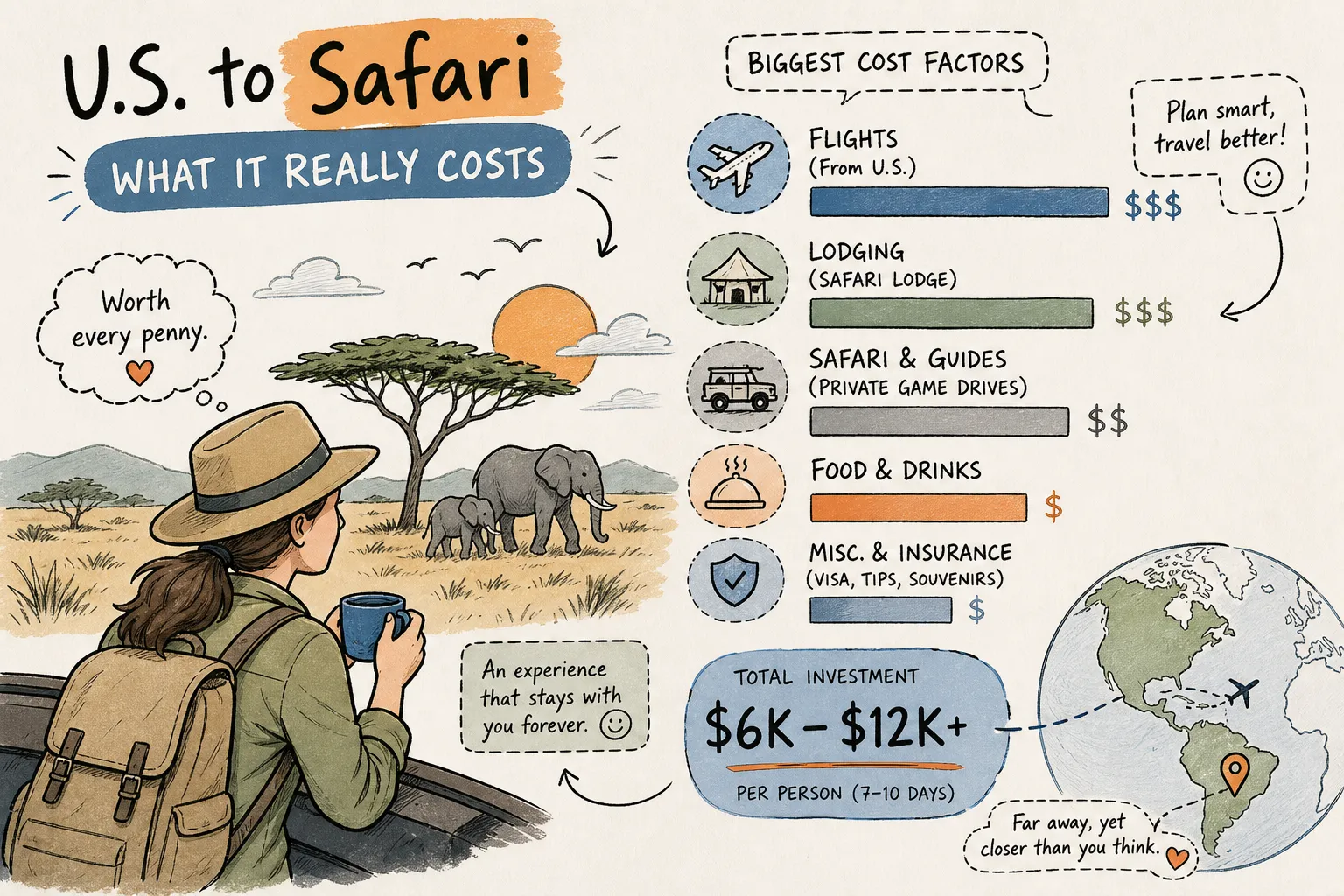
If you're asking what is the average cost of a safari trip from the US, the honest answer is that most articles quote "$3,000 to $25,000" and leave it at that. That range is technically accurate and completely useless for planning. What you actually pay for a safari departing from the US depends on five or six moving parts, and once you understand each one, building a realistic budget becomes straightforward instead of overwhelming.
This guide breaks down every cost component with real 2026 USD figures: round-trip airfare from major US cities, safari package rates by tier and destination, the extras that catch most first-timers off guard, and what a complete 7- or 10-day trip realistically runs per person. If you want to skip straight from these averages to an actual quote for your specific trip, the fastest move is to submit one inquiry on SafariAnswers and receive competing bids from verified local operators. More on that at the end. First, the framework.
This guide breaks down every cost component with real 2026 USD figures: round-trip airfare from major US cities, safari package rates by tier and destination, the extras that catch most first-timers off guard, and what a complete 7- or 10-day trip realistically runs per person. If you want to skip straight from these averages to an actual quote for your specific trip, the fastest move is to submit one inquiry on SafariAnswers and receive competing bids from verified local operators. More on that at the end. First, the framework.
The Real Components of Your Total Safari Budget
Before any numbers make sense, you need to understand what operators are actually quoting you. Most safari prices are structured as a per-person, per-day rate. That daily rate typically bundles accommodation, all meals (usually full board), park fees, game drives, and ground transfers. In mid-range and luxury packages, domestic or charter flights between camps are often included. Budget packages typically do not include them.
Think of your total safari cost in two distinct buckets. The first is your operator quote: everything that happens once you land in Africa. The second is your US-side travel costs: international airfare, travel insurance, visas, vaccinations, and gear. Safari operators never include international flights in their quotes, and most exclude gratuities, travel insurance, and visa fees as well. Keeping these two buckets separate from the start prevents the most common budgeting mistake, treating an operator quote as a total trip cost.
Think of your total safari cost in two distinct buckets. The first is your operator quote: everything that happens once you land in Africa. The second is your US-side travel costs: international airfare, travel insurance, visas, vaccinations, and gear. Safari operators never include international flights in their quotes, and most exclude gratuities, travel insurance, and visa fees as well. Keeping these two buckets separate from the start prevents the most common budgeting mistake, treating an operator quote as a total trip cost.
What Is the Average Cost of a Safari Trip from the US: Flights and Packages
International airfare is the largest single cost outside your safari package, and the range is wide. From New York (JFK or EWR) to Nairobi, round-trip economy fares in 2026 are running approximately $900 to $1,150, based on published fares across carriers including Kenya Airways, United, and Emirates routings. You can review current New York to Nairobi fares on major flight search pages to validate those ranges and timing, for example checking New York (JFK) to Nairobi flights.
From Los Angeles to Nairobi, fares range from roughly $876 to $1,344 depending on airline and travel month; see live pricing for Los Angeles to Nairobi flights to compare carriers and dates. Atlanta fares to East Africa typically fall in a similar range to New York, though routing options are more limited.
For Southern Africa, routes to Johannesburg or Cape Town from major US hubs run approximately $1,000 to $1,800 or more, depending on routing, stops, and how far out you book. Luxury travelers flying business class should budget $4,000 to $8,000 or more round-trip. Booking four to six months in advance consistently yields the best economy fares for long-haul routes to Africa. Last-minute airfare to Africa rarely drops, waiting almost always costs you more.
From Los Angeles to Nairobi, fares range from roughly $876 to $1,344 depending on airline and travel month; see live pricing for Los Angeles to Nairobi flights to compare carriers and dates. Atlanta fares to East Africa typically fall in a similar range to New York, though routing options are more limited.
For Southern Africa, routes to Johannesburg or Cape Town from major US hubs run approximately $1,000 to $1,800 or more, depending on routing, stops, and how far out you book. Luxury travelers flying business class should budget $4,000 to $8,000 or more round-trip. Booking four to six months in advance consistently yields the best economy fares for long-haul routes to Africa. Last-minute airfare to Africa rarely drops, waiting almost always costs you more.
Safari Package Prices by Tier: What You Actually Pay Per Day
Per-day rates are the clearest way to compare packages across destinations and get a handle on the average safari trip cost from the US. The tiers below reflect real 2026 pricing across four major safari destinations.
Budget Safaris: $150 to $350 Per Person Per Day
In Kenya and Tanzania, the budget tier means group camping or basic tented lodges, shared game drives in overland vehicles, and park fees that are usually included in the quoted rate. You still get genuine wildlife access and experienced guides; what you give up is exclusivity and comfort. South Africa offers the most accessible entry point in this tier: a self-drive safari in Kruger National Park can bring your per-day cost down to $150 to $250, making it the smartest destination for travelers working with a tighter budget. If you're specifically looking for economical options, see curated Kenya budget safari packages for examples of real, low-cost itineraries.
Mid-Range Safaris: $350 to $750 Per Person Per Day
This is the most popular tier among American travelers, and for good reason. In Kenya and Tanzania, $350 to $750 per day buys en-suite tented camps, semi-private guiding, included park fees, and often domestic transfers between camps. South Africa's mid-range sits slightly lower at $250 to $400 per day, with private game reserves offering full board and quality guiding. Botswana enters the picture here at $600 to $1,100 per day, the low end for that country, due to its limited-volume tourism policy and higher concession fees across its reserves.
Luxury Safaris: $750 to $4,000+ Per Person Per Day
Kenya and Tanzania luxury runs $750 to $1,500 or more per day, covering high-end camps, fly-in itineraries, exclusive wildlife concessions, and premium guiding. Botswana commands the highest prices in Africa at the luxury level, with rates ranging from $1,500 to $4,000 or more per day. That premium reflects a national policy of low-volume, high-value tourism: fewer visitors, larger concessions, and far less congestion at wildlife sightings. If you want a remote, uncrowded safari experience, Botswana delivers it, at a price.
The Extra Costs Most Travelers Forget to Include
Visas are one of the most overlooked line items for US travelers heading to East Africa. Kenya requires an Electronic Travel Authorization (eTA), which currently costs $30 for US passport holders. For the latest on Kenya's eTA requirements and how the policy applies to different nationalities, see the analysis from immigration specialists at Fragomen on Kenya's electronic travel authorization. Tanzania charges a visa on arrival, typically $50. South Africa requires no visa at all for US citizens as of 2026. These amounts are small, but failing to factor them in is a sign that other costs may be slipping through the cracks as well.
Travel insurance deserves serious budget attention. The industry standard is 4% to 10% of total trip cost. On a $6,000 trip, that's $240 to $600. On a $15,000 trip, it can reach $1,500. Given the cost of medical evacuation from a remote African reserve, travel insurance is not optional at this price point, consider providers that specialize in African safaris when comparing plans; for examples of appropriate coverage, see resources on travel insurance for an African safari. Vaccinations and travel clinic visits add another $0 to $300 depending on your destinations and existing immunizations. Yellow Fever vaccination is required for certain East Africa routes, so check your itinerary carefully before your travel clinic appointment.
Tipping is the extra cost that catches travelers most off guard once they're on the ground. A widely cited East Africa standard is $20 to $30 per day for your guide or driver, and $10 to $20 per day per guest for lodge staff. Over a 7-day trip, that adds up to $200 to $350 in tips alone, often more if you're staying at multiple camps with separate staff teams.
Budget another $100 to $400 for gear if this is your first safari. Neutral-colored clothing, a quality daypack, binoculars, and a universal power adapter are the essentials most people need to purchase before departure.
Travel insurance deserves serious budget attention. The industry standard is 4% to 10% of total trip cost. On a $6,000 trip, that's $240 to $600. On a $15,000 trip, it can reach $1,500. Given the cost of medical evacuation from a remote African reserve, travel insurance is not optional at this price point, consider providers that specialize in African safaris when comparing plans; for examples of appropriate coverage, see resources on travel insurance for an African safari. Vaccinations and travel clinic visits add another $0 to $300 depending on your destinations and existing immunizations. Yellow Fever vaccination is required for certain East Africa routes, so check your itinerary carefully before your travel clinic appointment.
Tipping is the extra cost that catches travelers most off guard once they're on the ground. A widely cited East Africa standard is $20 to $30 per day for your guide or driver, and $10 to $20 per day per guest for lodge staff. Over a 7-day trip, that adds up to $200 to $350 in tips alone, often more if you're staying at multiple camps with separate staff teams.
Budget another $100 to $400 for gear if this is your first safari. Neutral-colored clothing, a quality daypack, binoculars, and a universal power adapter are the essentials most people need to purchase before departure.
Average Per-Person Safari Trip Cost from the US: Sample Budgets by Tier
Combining airfare, per-day safari rates, and additional expenses produces realistic planning figures for the most common trip lengths. These numbers give you a direct answer to what the average cost of a safari trip from the US looks like across budget, mid-range, and luxury options.
For a 7-day safari, expect the following per-person totals, assuming double occupancy:
Budget tier: $3,800 to $6,800. This assumes economy airfare of $1,000 to $1,200, a safari package at $200 to $300 per day, and $500 to $700 for visas, insurance, tips, and incidentals.
Mid-range tier: $5,150 to $8,550. Same airfare assumption, $350 to $750 per day for the package, and similar additional costs.
Luxury tier: $9,300 to $16,500 or more. Economy airfare plus $750 to $1,500 or more per day for the package.
A 10-day safari adds three days of package cost and often the opportunity to include a second destination, a fly-in camp upgrade, or a beach extension such as Zanzibar or Cape Town:
Budget tier: $4,700 to $8,800 per person
Mid-range tier: $6,500 to $12,150 per person
Luxury tier: $12,000 to $25,000 or more per person
Solo travelers should factor in a single supplement, which most operators charge when a room or tent is occupied by one person. Single supplements commonly run 20% to 40% above the per-person double occupancy rate, so a 7-day mid-range safari that costs $6,000 per person sharing could run $7,200 to $8,400 for a solo traveler.
For a 7-day safari, expect the following per-person totals, assuming double occupancy:
Budget tier: $3,800 to $6,800. This assumes economy airfare of $1,000 to $1,200, a safari package at $200 to $300 per day, and $500 to $700 for visas, insurance, tips, and incidentals.
Mid-range tier: $5,150 to $8,550. Same airfare assumption, $350 to $750 per day for the package, and similar additional costs.
Luxury tier: $9,300 to $16,500 or more. Economy airfare plus $750 to $1,500 or more per day for the package.
A 10-day safari adds three days of package cost and often the opportunity to include a second destination, a fly-in camp upgrade, or a beach extension such as Zanzibar or Cape Town:
Budget tier: $4,700 to $8,800 per person
Mid-range tier: $6,500 to $12,150 per person
Luxury tier: $12,000 to $25,000 or more per person
Solo travelers should factor in a single supplement, which most operators charge when a room or tent is occupied by one person. Single supplements commonly run 20% to 40% above the per-person double occupancy rate, so a 7-day mid-range safari that costs $6,000 per person sharing could run $7,200 to $8,400 for a solo traveler.
How to Find Out What Your Specific Safari Would Actually Cost
Averages and tiers are useful for calibration. They are not a quote. A generic estimate from any travel article, including this one, cannot account for your specific travel dates, group size, preferred parks, accommodation style, or the seasonal pricing shifts that move some camp rates by 30% or more between low and high season. The numbers above tell you what tier you're in. They do not tell you what a reputable operator in Kenya would actually charge you for your 9-night itinerary in October.
The biggest pricing factor most American travelers don't consider is international agency markup. When a US-based travel agency books an African safari on your behalf, they typically layer 20% to 40% over what a locally based operator charges directly. That markup pays for their overhead, not for a better safari. On a $10,000 trip, that's $2,000 to $4,000 in additional cost for the same itinerary, the same camps, and the same guides.
This is exactly the problem SafariAnswers is built to solve. You submit one detailed inquiry with your destination, travel dates, group size, and budget, essentially a single quote request and a detailed itinerary, and verified local operators in East and Southern Africa then send you personalized bids that you can compare side by side: accommodation tier, meals included, park fees, internal flights, and transfers. Every operator on the platform is pre-vetted, legally registered, and has a public review record from past travelers, so the comparison is on value, not credibility. You can also browse the community Q&A to get real answers from local experts before any money changes hands. After reading this article, you know what a fair per-day rate looks like and what should be included in a solid quote. SafariAnswers is where you take that knowledge and get your actual number.
The biggest pricing factor most American travelers don't consider is international agency markup. When a US-based travel agency books an African safari on your behalf, they typically layer 20% to 40% over what a locally based operator charges directly. That markup pays for their overhead, not for a better safari. On a $10,000 trip, that's $2,000 to $4,000 in additional cost for the same itinerary, the same camps, and the same guides.
This is exactly the problem SafariAnswers is built to solve. You submit one detailed inquiry with your destination, travel dates, group size, and budget, essentially a single quote request and a detailed itinerary, and verified local operators in East and Southern Africa then send you personalized bids that you can compare side by side: accommodation tier, meals included, park fees, internal flights, and transfers. Every operator on the platform is pre-vetted, legally registered, and has a public review record from past travelers, so the comparison is on value, not credibility. You can also browse the community Q&A to get real answers from local experts before any money changes hands. After reading this article, you know what a fair per-day rate looks like and what should be included in a solid quote. SafariAnswers is where you take that knowledge and get your actual number.
You Now Have What Most Booked Travelers Didn't Have When They Paid
The total cost of a safari from the US runs from roughly $3,800 to $25,000 or more per person, depending on tier, duration, and destination. That range is wide because the choices are wide. The math itself is simple: flights plus daily safari rate plus additional expenses equals your total. Once you know which tier fits your goals and how long you want to go, the estimate comes into focus quickly.
The next step is not more research. It's getting real quotes from real operators who know exactly what a 7-day Maasai Mara safari costs right now, not based on a blog post from six months ago, but based on what they're booking for travelers today, including current Maasai Mara entry fees and seasonally adjusted package rates. Submit one inquiry on SafariAnswers, compare what local operators offer for your specific trip, and you'll have your actual number within days. Most travelers who've already booked didn't have the framework you now have. Use it. For available short-term deals, see the platform's live listings of Kenya & Tanzania Safari Packages.
The next step is not more research. It's getting real quotes from real operators who know exactly what a 7-day Maasai Mara safari costs right now, not based on a blog post from six months ago, but based on what they're booking for travelers today, including current Maasai Mara entry fees and seasonally adjusted package rates. Submit one inquiry on SafariAnswers, compare what local operators offer for your specific trip, and you'll have your actual number within days. Most travelers who've already booked didn't have the framework you now have. Use it. For available short-term deals, see the platform's live listings of Kenya & Tanzania Safari Packages.
Frequently Asked Questions: Safari Trip Costs from the US
What is the average cost of a safari trip from the US in 2026?
The average cost of a safari trip from the US in 2026 ranges from about $3,800 to $25,000 or more per person for a 7- to 10-day trip, depending on the destination, accommodation tier, and time of year. Budget travelers can keep costs closer to $4,000 to $7,000; mid-range trips typically run $5,000 to $12,000; and luxury itineraries routinely exceed $15,000 per person once flights are included.
Does the average safari cost from the US include flights?
Safari operator quotes never include international flights from the US. Round-trip economy airfare from major US cities to East or Southern Africa typically adds $900 to $1,800 per person. Always calculate flights separately from your operator package when building a total trip budget.
What is the cheapest way to do a safari from the US?
The most affordable approach is a self-drive safari in South Africa's Kruger National Park, which can bring per-day costs down to $150 to $250. Pair that with economy flights booked four to six months in advance and you can keep a 7-day trip under $5,000 per person. Booking directly with locally based operators, rather than through a US-based agency, also removes a 20% to 40% markup from your total.
How much extra should I budget beyond the safari package price?
Plan on an additional $800 to $1,500 per person for international flights, travel insurance (4% to 10% of trip cost), visa fees, vaccinations, tipping ($200 to $350 for a 7-day trip), and basic gear. These costs are rarely included in operator quotes but consistently add up to a meaningful share of the total trip budget.
The average cost of a safari trip from the US in 2026 ranges from about $3,800 to $25,000 or more per person for a 7- to 10-day trip, depending on the destination, accommodation tier, and time of year. Budget travelers can keep costs closer to $4,000 to $7,000; mid-range trips typically run $5,000 to $12,000; and luxury itineraries routinely exceed $15,000 per person once flights are included.
Does the average safari cost from the US include flights?
Safari operator quotes never include international flights from the US. Round-trip economy airfare from major US cities to East or Southern Africa typically adds $900 to $1,800 per person. Always calculate flights separately from your operator package when building a total trip budget.
What is the cheapest way to do a safari from the US?
The most affordable approach is a self-drive safari in South Africa's Kruger National Park, which can bring per-day costs down to $150 to $250. Pair that with economy flights booked four to six months in advance and you can keep a 7-day trip under $5,000 per person. Booking directly with locally based operators, rather than through a US-based agency, also removes a 20% to 40% markup from your total.
How much extra should I budget beyond the safari package price?
Plan on an additional $800 to $1,500 per person for international flights, travel insurance (4% to 10% of trip cost), visa fees, vaccinations, tipping ($200 to $350 for a 7-day trip), and basic gear. These costs are rarely included in operator quotes but consistently add up to a meaningful share of the total trip budget.