
Safari Itinerary Guide: How to Structure Your Perfect Trip
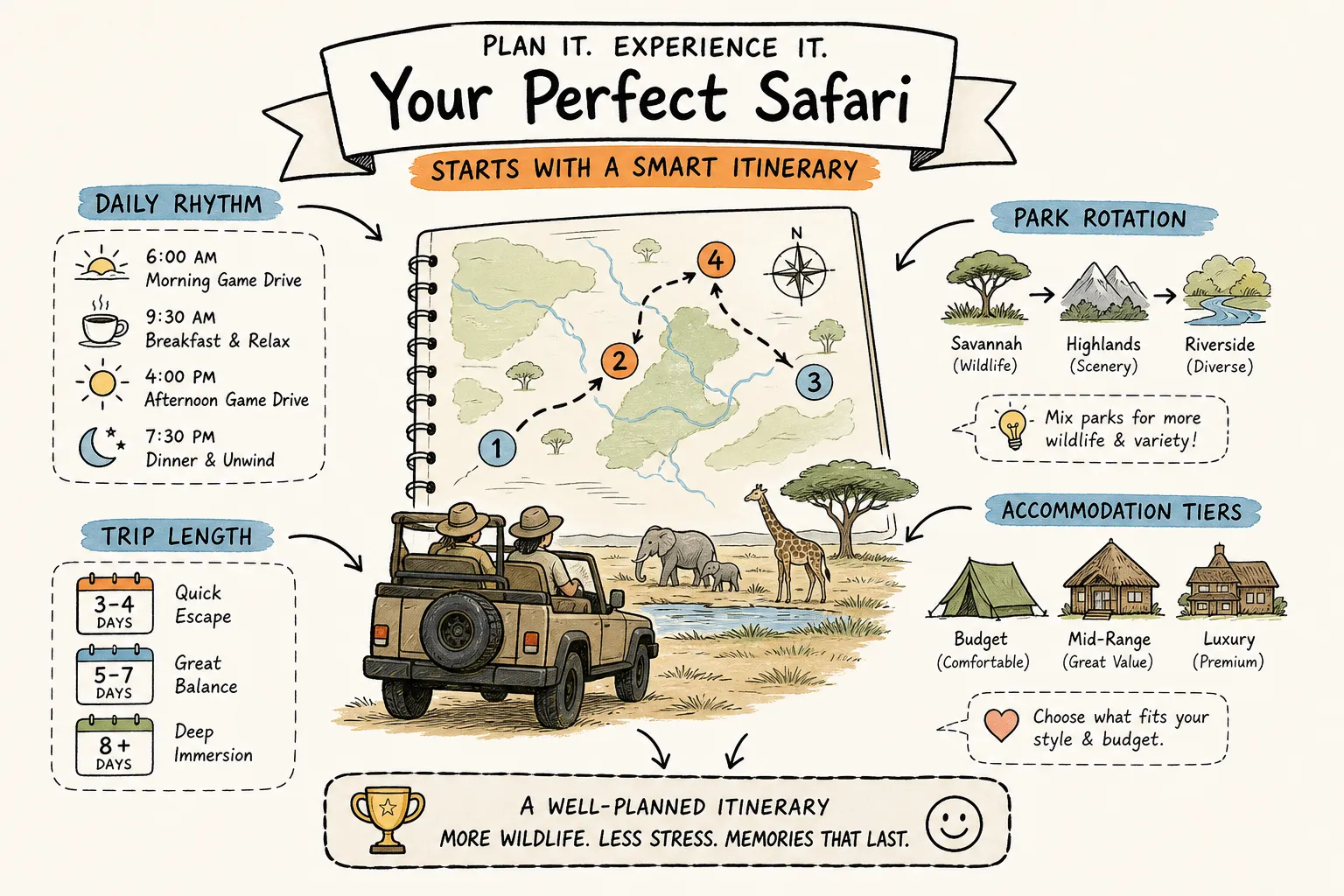
Most safari planning mistakes don't happen at the destination stage. They happen at the structure stage, when travelers pick a country without knowing how many parks to include, how long to stay in each one, or what a real safari day actually looks like. This safari itinerary guide covers exactly that: daily game drive schedules, park rotation logic, accommodation tiers, seasonal timing, and honest cost ranges by destination. Use it to build a clear picture of what your trip should contain and the right questions to ask any operator before you commit.
Whether you're working with 5 days or 12, understanding the anatomy of a well-built trip is what separates travelers who get great value from those who feel shortchanged at the end. This guide walks through each structural element so you can evaluate any proposal with confidence.
SafariAnswers was built for exactly this problem. Submit one inquiry and receive multiple fully customized itineraries from local operators across East and Southern Africa, then compare them side by side before spending a dollar. Operators on the platform are locally based, legally registered, and reviewed by past travelers.
Whether you're working with 5 days or 12, understanding the anatomy of a well-built trip is what separates travelers who get great value from those who feel shortchanged at the end. This guide walks through each structural element so you can evaluate any proposal with confidence.
SafariAnswers was built for exactly this problem. Submit one inquiry and receive multiple fully customized itineraries from local operators across East and Southern Africa, then compare them side by side before spending a dollar. Operators on the platform are locally based, legally registered, and reviewed by past travelers.
What a well-structured safari itinerary guide actually contains
A strong safari itinerary is not a list of parks. It's a timed sequence of game drives, rest periods, accommodation moves, and strategic park selections built around wildlife behavior and your travel window. Understanding that structure before you look at any operator proposal is what separates travelers who get great value from those who feel shortchanged at the end of the trip.
The daily game drive rhythm
Every well-planned safari day follows the same core structure: an early morning drive starting around 6:00 a.m. when animals are most active, a midday rest at camp when heat reduces wildlife movement, and an afternoon drive that runs into sunset. Most quality game viewing happens in those two windows, not in a single long haul. Operators who cram three parks into two days cut directly into that rhythm and reduce the quality of what you actually see.
Minimum nights per park
Spending a single night in a major park like the Serengeti or the Maasai Mara is almost always a waste. Two nights gives you two morning and two afternoon drives; three to four nights is the standard for major parks. That range gives you enough time for wildlife patterns to reveal themselves and for weather variation to work in your favor. For first-time visitors to the Serengeti specifically, three nights is the practical minimum and four is better.
Accommodation tiers and itinerary flexibility
Where you sleep determines what your itinerary can do. Budget camping and basic tented camps often have stricter curfew or lighting constraints than their upscale counterparts, limiting evening flexibility. Mid-range lodges offer structured meals and guided walks on a more fixed schedule. Luxury camps add private game drives, bush dinners, and flexible timing that lets the guide chase a sighting without watching a clock. Choosing your tier upfront isn't just a cost decision; it shapes the entire daily structure of your trip. For more on the practical differences between fixed lodges and mobile or tented camps, see a helpful comparison of safari lodge vs tented camp.
How trip length shapes your safari itinerary options
The number of days you have is the single biggest constraint on which parks and countries you can realistically include. Trying to cover too much ground in too little time turns a safari into a transfer marathon, and that's the mistake many first-time planners make when they build their own itinerary without local guidance.
5- and 7-day safaris: what's actually realistic
Five days works well if you concentrate. In Tanzania, a compact 5-day circuit covering Tarangire, Lake Manyara, the Serengeti, and Ngorongoro Crater is doable, though transfers can consume a significant portion of each travel day, so pace expectations accordingly. In Kenya, five days focused entirely on the Maasai Mara gives you genuine game-viewing depth. Adding a second country or more than three or four parks in under a week usually means trading wildlife time for vehicle time.
Seven days opens up more movement. A solid 7-day Kenya safari connects Amboseli for elephants, the Rift Valley lakes, and the Mara for big cats. In Tanzania, seven days adds extra nights in the Serengeti and a more relaxed pace through Ngorongoro. Both routes work well for first-time travelers who want variety without sacrificing depth in any single location.
Seven days opens up more movement. A solid 7-day Kenya safari connects Amboseli for elephants, the Rift Valley lakes, and the Mara for big cats. In Tanzania, seven days adds extra nights in the Serengeti and a more relaxed pace through Ngorongoro. Both routes work well for first-time travelers who want variety without sacrificing depth in any single location.
10- and 12-day trips: room for depth and cross-border routes
Ten to twelve days is where multi-destination and cross-border itineraries start to make sense. A Kenya-Tanzania combination covering the Mara and the Serengeti corridor is one of the most popular 10-day routes, the reason is straightforward: you're following the same ecosystem across two countries. In Southern Africa, 10 days lets you combine Kruger with Cape Town or Botswana's Okavango Delta without feeling like you're just passing through.
Twelve days is the sweet spot for first-time travelers who want both variety and enough time in each location to actually experience it. A full northern Tanzania circuit with longer Serengeti stays, or a multi-area Botswana route covering Chobe, Savuti, Moremi, and the Delta, both work comfortably at 12 days. The key is resisting the urge to add more destinations and instead using the extra days to go deeper.
Twelve days is the sweet spot for first-time travelers who want both variety and enough time in each location to actually experience it. A full northern Tanzania circuit with longer Serengeti stays, or a multi-area Botswana route covering Chobe, Savuti, Moremi, and the Delta, both work comfortably at 12 days. The key is resisting the urge to add more destinations and instead using the extra days to go deeper.
Matching your destination to your safari goals
The four most popular safari countries for American travelers each offer a distinct experience. The best one for you depends on what you're prioritizing, iconic migration, raw wilderness, accessibility, or exclusivity. Knowing the difference before you start comparing itineraries prevents you from booking the wrong destination entirely.
East Africa: Kenya and Tanzania
Kenya and Tanzania are the default starting point for first-time safari travelers, the wildlife density and infrastructure justify the reputation. The Maasai Mara and the Serengeti share an ecosystem and the same wildlife, including the annual Great Migration of wildebeest between the two. Tanzania's northern circuit adds Ngorongoro Crater, one of the most wildlife-dense areas on the continent. Kenya pairs well with a shorter trip; Tanzania rewards longer stays. If you need operator recommendations focused on Kenya specifically, consult Best Safari Operators in Kenya: How to Find a Trusted One.
Southern Africa: South Africa and Botswana
South Africa's Kruger National Park is one of the most accessible major safari destinations in Africa, with well-maintained roads, a wide range of accommodation options, and designated malaria-free zones that make it a practical choice for families or travelers with health considerations. Botswana takes the opposite approach: remote, low-volume, high-cost, and built around water-based game viewing in the Okavango Delta and Chobe River. If exclusivity and off-the-beaten-path experiences matter more than price, Botswana delivers. If accessibility and budget flexibility are your priorities, South Africa is hard to beat.
When to go and how season shapes your plan
Season doesn't just affect what you'll see. It affects park access, accommodation prices, booking availability, and how your day-by-day schedule holds up in the field. Building your itinerary around the right seasonal window is as important as choosing the right destination.
Peak wildlife months by region
The dry season consistently produces the best general game viewing across most African destinations. In the Serengeti and Ngorongoro, June through October brings sparse vegetation and concentrated wildlife around water. January and February are the hidden gems for the Ndutu calving season, when predator activity peaks in the southern Serengeti. The Maasai Mara peaks from July through October for the Great Migration river crossings, and Kruger, the Okavango Delta, and Chobe all follow a similar May-to-October dry-season window. For an authoritative overview of timing in the Serengeti, see this guide to the best time to visit the Serengeti.
How peak season affects your planning timeline
Premium lodges and camps in popular destinations routinely book out 12 to 18 months in advance during peak season, and some top properties fill even earlier. Building your itinerary around your preferred travel dates, rather than choosing dates after locking in the route, prevents the most common planning failure: arriving during peak wildlife season with only second-choice accommodation available. If you're targeting July through October in the Mara or Serengeti for 2026, you should already be researching and securing camps given those long lead times.
What your safari should cost by tier and destination
Cost ranges on safari vary more than most travelers expect, and the gap between budget and luxury isn't just comfort, it's access, flexibility, and the quality of the itinerary itself. Understanding the real numbers by country and tier is what lets you evaluate any quote accurately.
Per-person daily cost ranges
South Africa is consistently the most affordable major destination. Budget safaris run around $150 to $250 per person per day, mid-range options land at $250 to $400, and luxury experiences start around $400. Kenya and Tanzania sit higher: mid-range typically runs $350 to $550 per day, and luxury camps range from $700 to over $2,000 depending on the operator and location. Botswana is the most expensive destination on the continent, with remote fly-in camps in the Okavango Delta regularly reaching $1,000 to $2,500 per day at the luxury end.
For a practical 7-day benchmark in Tanzania or Kenya in 2026, expect to spend roughly $2,500 to $4,500 per person at mid-range and $5,500 to $10,000 at luxury. Budget trips to East Africa are possible, but Tanzania's mandatory daily park fees combined with limited low-cost accommodation in prime wildlife zones push the floor higher than most travelers anticipate. For a closer look at typical charges and how they add up on a Kenya-Tanzania route, consult this Kenya-Tanzania safari cost overview.
For a practical 7-day benchmark in Tanzania or Kenya in 2026, expect to spend roughly $2,500 to $4,500 per person at mid-range and $5,500 to $10,000 at luxury. Budget trips to East Africa are possible, but Tanzania's mandatory daily park fees combined with limited low-cost accommodation in prime wildlife zones push the floor higher than most travelers anticipate. For a closer look at typical charges and how they add up on a Kenya-Tanzania route, consult this Kenya-Tanzania safari cost overview.
What drives the biggest price jumps
The largest cost differences come from accommodation level, transport method between parks, park fee structures, and whether you're on a shared group vehicle or a private game drive. Tanzania's mandatory daily park entry fees are among the highest in Africa and factor significantly into any operator quote. Fly-in charters between remote camps add cost quickly but save full travel days and reduce fatigue on longer itineraries. Knowing which cost levers your itinerary is pulling helps you compare quotes accurately rather than just comparing headline numbers.
How to get a custom itinerary and compare your real options
Once you understand what a good safari itinerary contains, the next step is getting one built specifically for your dates, budget, and goals, and then having real options to compare. Generic package tours don't do this. They start with a fixed product and see whether you fit inside it.
What to ask operators before accepting any proposal
A well-structured itinerary proposal from any operator should include specific lodge or camp names, confirmed park fees broken out in the total cost, game drive schedules per day, transport methods between locations, and a clear list of what's excluded. If a quote doesn't specify which camps or doesn't break out park fees, ask before accepting it as comparable to other quotes. Vague proposals are a sign that the operator is either inexperienced or building in margin they don't want you to see.
How SafariAnswers puts local operators in competition for your trip
SafariAnswers was designed for exactly this stage of planning. You submit one inquiry with your destination, travel dates, group size, and budget. Local operators across East and Southern Africa respond with their own fully built custom itineraries. You review and compare those proposals side by side on one platform, with full visibility into camp selections, inclusions, and pricing, without going through an international middleman that adds margin without adding value. If you're still deciding whether to book directly with a local company or through an agent, read is it better to book a safari directly with a local operator or via an agent? Operators on SafariAnswers are locally based, legally registered, and reviewed by past travelers, so the vetting work is already done before you read a single proposal.
Sample safari itineraries: two practical starting points
The frameworks above become easier to apply when you can see them mapped onto a real schedule. These two samples show how the structural principles, minimum nights per park, two drives per day, realistic transfer times, translate into an actual day-by-day plan.
Sample 5-day Tanzania itinerary
Day 1: Arrive Kilimanjaro International Airport; afternoon transfer to Tarangire National Park; sunset drive.
Day 2: Full day in Tarangire, morning and afternoon game drives; night in camp.
Day 3: Morning drive, then transfer to Ngorongoro Conservation Area; afternoon descent into the Crater.
Day 4: Full Crater floor game drive; transfer to central Serengeti; afternoon arrival drive.
Day 5: Early morning Serengeti drive; transfer to Arusha for departure flight.
This route is tight, Day 5 sacrifices a full Serengeti afternoon for logistics, but it covers the northern circuit's four signature zones. Adding even one night to the Serengeti leg significantly improves the experience.
Day 2: Full day in Tarangire, morning and afternoon game drives; night in camp.
Day 3: Morning drive, then transfer to Ngorongoro Conservation Area; afternoon descent into the Crater.
Day 4: Full Crater floor game drive; transfer to central Serengeti; afternoon arrival drive.
Day 5: Early morning Serengeti drive; transfer to Arusha for departure flight.
This route is tight, Day 5 sacrifices a full Serengeti afternoon for logistics, but it covers the northern circuit's four signature zones. Adding even one night to the Serengeti leg significantly improves the experience.
Sample 7-day Kenya itinerary
Day 1: Arrive Nairobi; afternoon transfer to Amboseli National Park.
Day 2: Full day in Amboseli, elephants against Kilimanjaro backdrop; two drives.
Day 3: Morning drive; road or charter transfer to a Rift Valley lodge (Lake Naivasha or Lake Nakuru area); afternoon activity.
Day 4: Morning lake or crater rim experience; transfer to Maasai Mara; afternoon arrival drive.
Days 5, 6: Two full days in the Mara, morning and afternoon drives; optional balloon safari on Day 6 morning.
Day 7: Early morning drive; charter or road transfer to Nairobi for departure.
This itinerary delivers three distinct ecosystems in seven days without feeling like a relay race. The two full Mara days are the anchor, don't compress them.
Day 2: Full day in Amboseli, elephants against Kilimanjaro backdrop; two drives.
Day 3: Morning drive; road or charter transfer to a Rift Valley lodge (Lake Naivasha or Lake Nakuru area); afternoon activity.
Day 4: Morning lake or crater rim experience; transfer to Maasai Mara; afternoon arrival drive.
Days 5, 6: Two full days in the Mara, morning and afternoon drives; optional balloon safari on Day 6 morning.
Day 7: Early morning drive; charter or road transfer to Nairobi for departure.
This itinerary delivers three distinct ecosystems in seven days without feeling like a relay race. The two full Mara days are the anchor, don't compress them.
Safari packing essentials
* Neutral-colored clothing, khaki, olive, tan; avoid white and bright colors
* Layers, early morning drives are cold year-round in most safari regions
* Wide-brim hat and high-SPF sunscreen, open vehicles mean full sun exposure
* Quality binoculars, 8x42 is the standard field recommendation
* Camera with a zoom lens, 200mm minimum; 400mm or more for birds and distant cats
* Dust bag or dry bag for camera gear on game drives
* Power bank, remote camps often have limited charging windows
* Malaria prophylaxis, consult your doctor; required for most East Africa and Botswana destinations
* Yellow fever certificate, required entry document for several East African countries
* Soft-sided luggage only, hard cases are prohibited on most light charter aircraft
For a printable, detailed checklist you can cross-reference with your luggage, see this comprehensive safari packing list.
* Layers, early morning drives are cold year-round in most safari regions
* Wide-brim hat and high-SPF sunscreen, open vehicles mean full sun exposure
* Quality binoculars, 8x42 is the standard field recommendation
* Camera with a zoom lens, 200mm minimum; 400mm or more for birds and distant cats
* Dust bag or dry bag for camera gear on game drives
* Power bank, remote camps often have limited charging windows
* Malaria prophylaxis, consult your doctor; required for most East Africa and Botswana destinations
* Yellow fever certificate, required entry document for several East African countries
* Soft-sided luggage only, hard cases are prohibited on most light charter aircraft
For a printable, detailed checklist you can cross-reference with your luggage, see this comprehensive safari packing list.
Start with the structure, then build the trip
A well-built safari itinerary isn't complicated once you understand how the pieces fit together. Start with your trip length, match it to a realistic destination, build the daily game drive schedule around wildlife behavior, and choose an accommodation tier that fits both your budget and your priorities. The patterns hold across destinations: two to four nights per major park, two game drives per day, dry-season timing for most regions, and enough lead time to secure the camps you actually want.
What changes is the specific country, the cost range, and the operator building the plan. Use this safari itinerary guide to evaluate any proposal with confidence, ask the right follow-up questions, and recognize when a quote is genuinely competitive versus when you're being sold convenience at a premium.
The next step is putting real itineraries in front of you. Use SafariAnswers to submit your trip details and receive competing custom itineraries from verified local operators, part of our broader safari trip planner tools built to take the guesswork out of this process. Compare them on your own terms, ask the right questions, and book directly with the operator who earns your confidence. For guidance on submitting a detailed request and receiving a tailored quote, see planning a trip to Kenya and Tanzania quote request and a detailed itinerary.
What changes is the specific country, the cost range, and the operator building the plan. Use this safari itinerary guide to evaluate any proposal with confidence, ask the right follow-up questions, and recognize when a quote is genuinely competitive versus when you're being sold convenience at a premium.
The next step is putting real itineraries in front of you. Use SafariAnswers to submit your trip details and receive competing custom itineraries from verified local operators, part of our broader safari trip planner tools built to take the guesswork out of this process. Compare them on your own terms, ask the right questions, and book directly with the operator who earns your confidence. For guidance on submitting a detailed request and receiving a tailored quote, see planning a trip to Kenya and Tanzania quote request and a detailed itinerary.