
Booking Safari Direct vs. Travel Agent: The Real Answer
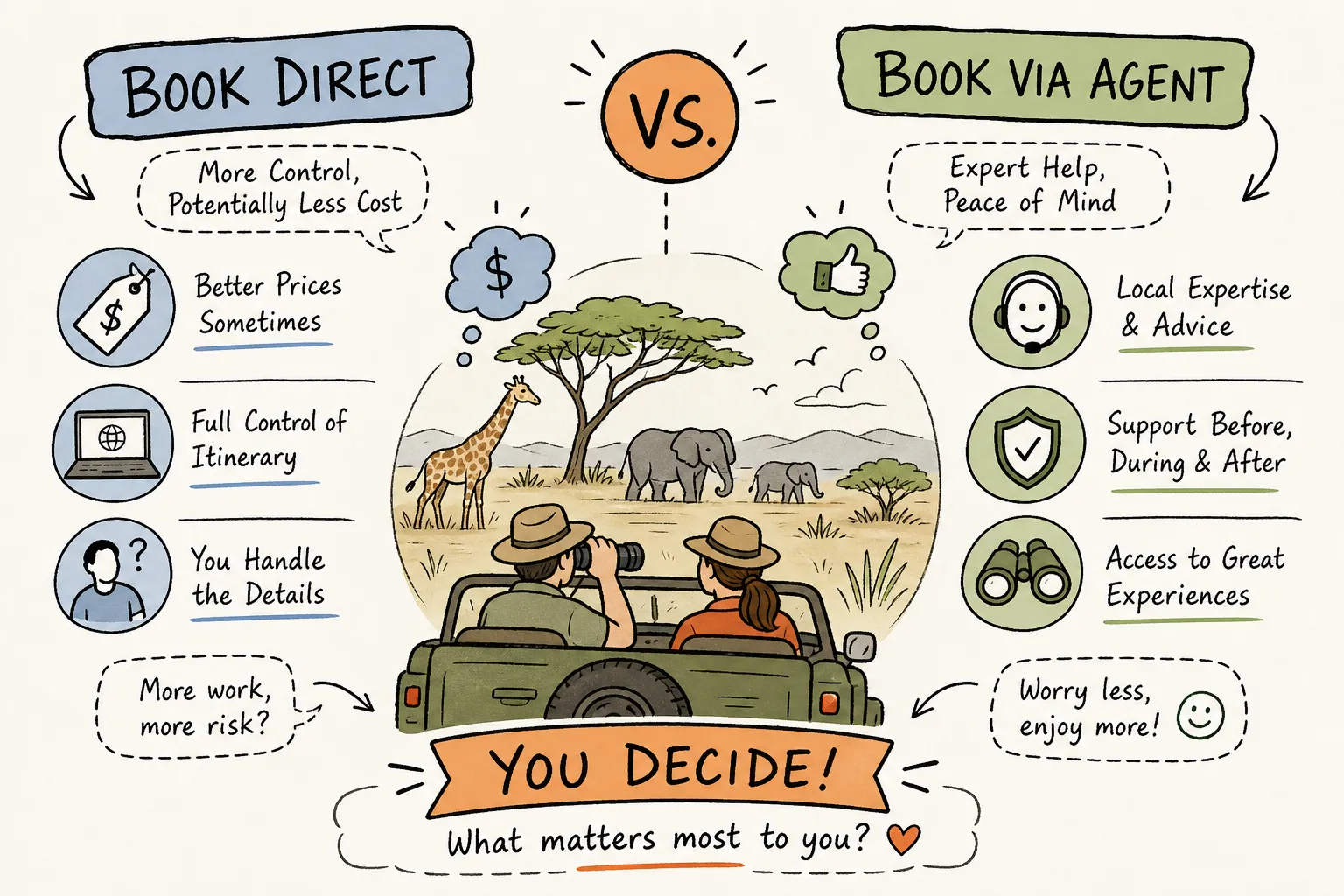
Is it better to book a safari directly with a local operator? You've found one in Kenya with 47 glowing reviews and a price that's literally half what a US agency quoted you. The safari looks identical on paper. Do you trust it? For a trip you've been dreaming about and saving for, that's an uncomfortable question. This exact scenario lands in the SafariAnswers community inbox on a near-daily basis, and the honest answer is that both options can work well, but only under the right conditions. The tradeoff between booking a safari directly with a local operator versus going through an agent isn't a simple "one is better" answer. It depends on your destination, itinerary complexity, risk tolerance, and how much homework you're willing to do upfront. Below is a clear-eyed breakdown of real costs, genuine risks, and the specific situations where each approach wins, so you can make a confident call before spending a dollar.
What Booking a Safari Directly with a Local Operator Actually Saves You
The cost difference is real and significant. Booking a safari directly with a local operator typically runs 25% to 50% cheaper than booking the same trip through a US or UK-based agency. In some cases, overseas operators add 30% to 300% on top of local pricing. A safari priced at $3,000 direct could cost $4,500 to $9,000 through a premium US agency, depending on brand positioning and itinerary complexity.
Understanding why the gap exists helps you assess it honestly. The big fixed costs on any safari, park entry fees, accommodation, transport, guide wages, are largely the same regardless of who processes your booking. What changes is the layer of overseas overhead and margin stacked on top. A US agency carries marketing costs, staff salaries, office infrastructure, and a profit margin that all get baked into your quote. The local operator carries those costs too, but at a fraction of the scale.
Understanding why the gap exists helps you assess it honestly. The big fixed costs on any safari, park entry fees, accommodation, transport, guide wages, are largely the same regardless of who processes your booking. What changes is the layer of overseas overhead and margin stacked on top. A US agency carries marketing costs, staff salaries, office infrastructure, and a profit margin that all get baked into your quote. The local operator carries those costs too, but at a fraction of the scale.
Where the Savings Are Largest
Budget and mid-range safaris show the most dramatic price gaps. When accommodation runs $150 to $400 per person per night, the agency markup becomes a very large percentage of total trip cost. This is exactly the range where a $3,000 direct quote becomes a $5,000 or $6,000 agency quote, and where booking directly with a local operator delivers the clearest financial advantage. For regional price breakdowns see the East Africa safari cost guide.
Where the Savings Narrow
Luxury safaris above $800 to $1,000 per person per night are a different calculation. When accommodation cost dominates the budget and local operators are accessing the same trade rates from exclusive lodges, the absolute dollar gap shrinks. The savings math still favors going direct, but the percentage difference is smaller. At this level, the decision becomes more about control and customization than pure cost, think hand-picked camps, bespoke day-by-day pacing, and direct conversations with senior guides rather than a packaged itinerary built for scale.
Is It Better to Book a Safari Directly? Where Local Operators Have the Edge
Cost is only part of the picture. When you communicate directly with a ground-level operator, you get something an overseas agent structurally cannot offer: real-time itinerary flexibility. A local safari operator you email directly can swap a lodge for one with better recent leopard activity, add a morning game drive, or accommodate a dietary restriction without routing a request through three intermediaries. Changes that take a week through an agency happen in a day through a direct conversation.
Customization and Itinerary Flexibility
Pre-packaged safari tours sold by large international operators are designed to be repeatable and scalable, which means they're built around averages. A local operator building your itinerary from scratch can tailor day-by-day game drive timing, activity selection, and camp choices to your specific interests. For families traveling with young children, solo wildlife photographers, or groups with mixed mobility needs, that customization isn't a luxury, it's essential.
Local Expertise and Authentic Connections
Guides who've spent 15 years tracking animals in the Maasai Mara know things no overseas travel agent can know: which crossing point on the Mara River is most active this week, which camp manager is most responsive to special requests, which community-led conservation areas offer the most meaningful cultural exchanges. Working directly with these operators is what community-grounded safari travel actually looks like in practice, as opposed to in a brochure.
The Real Risks of Booking a Safari Direct with a Local Operator
This is where the safari booking pros and cons conversation gets uncomfortable, and it deserves your full attention. Booking directly with an in-country operator removes several layers of consumer protection that you may not notice are missing until something goes wrong. If a lodge double-books, if the operator goes dark after your deposit, or if a refund dispute arises mid-trip, you have far fewer escalation paths than you would with a package-travel-protected booking through a licensed agent.
Refund Disputes and Cancellation Risks
Safari inventory, park permits, lodge nights, internal charter flights, is committed far in advance and is genuinely difficult to resell. This means local operators often use firm, tiered cancellation policies, and deposits are frequently non-refundable once those costs are locked in with third parties. This is standard and reasonable. The real risk arises when there is no policy at all, when terms are verbal rather than written, or when an operator goes unresponsive after payment. Always get cancellation terms in writing before paying a deposit.
The Vetting Problem for Independent Travelers
Most travelers have no reliable way to verify whether an operator is legitimate before money changes hands. An impressive website, positive-sounding reviews, and a reasonable price tell you very little about whether the company is licensed, insured, and financially stable. This is the risk a good travel agent would normally absorb on your behalf, because they've already done the due diligence. When you book safari through a local operator directly, that responsibility shifts entirely to you. Helpful resources such as how to choose a trusted safari operator outline the due-diligence steps to take before you pay.
What Travel Agents Actually Do Better
A specialist safari agent earns their fee in three specific scenarios: multi-country itineraries, complex flight logistics, and financial protection. When your trip spans Kenya, Tanzania, and Rwanda, involves multiple internal prop-plane hops, and requires coordinating arrivals and departures across different international gateways, an experienced agent's supplier relationships have real operational value.
Managing Flights, Visas, and Multi-Lodge Coordination
International agents are more likely to bundle intercontinental and regional flights into a single package and manage cross-border logistics as a coordinated whole. In-country operators are specialists in their destination, but they typically focus on land arrangements and may assist with domestic or regional flights rather than owning your full air itinerary. For first-time travelers managing a 20-hour connection from a US hub with an internal flight into the Maasai Mara the next morning, having one point of contact for the entire chain matters, a single call resolves what might otherwise be a logistical crisis. Weigh the pros and cons of booking airline tickets directly versus using OTAs with resources like pros and cons of booking airline tickets directly vs OTAs, and be aware of common pitfalls such as the risks when booking your flight through a travel agency.
Consumer Protection and Financial Recourse
When you book a qualifying package through a licensed travel agent, package-travel regulations in many jurisdictions provide substitution rights and refund protections if a supplier fails. Booking a safari directly with a local operator does not carry the same built-in backstop. This is the agent's most legitimate value proposition, not their destination knowledge, but the legal liability coverage their booking structure provides. Paying by credit card and carrying comprehensive travel insurance goes a long way toward recreating this protection when booking direct, though it doesn't replicate it entirely.
How to Vet Any Local Operator Before Paying
The difference between an excellent direct booking and a costly mistake comes down entirely to vetting. Reputable operators leave a verifiable paper trail. In Kenya, check for membership in KATO (Kenya Association of Tour Operators) and licensing through the Tourism Regulatory Authority. In Tanzania, look for Tanzania Tourist Board registration and TATO affiliation. In South Africa, SATSA (Southern Africa Tourism Services Association) is the clearest trust signal. Ask for the operator's registration or license number and verify it independently on the relevant body's website. For more detail on vetting Kenyan operators, see Best Safari Operators in Kenya: How to Find a Trusted One.
Payment Methods and Red Flags to Watch
Legitimate operators accept bank transfer or credit card and provide written payment terms before any money changes hands. Cash-on-arrival as the primary payment option is a disqualifying signal, not a minor quirk. Other clear red flags: vague or missing cancellation terms, pressure to pay quickly, no explanation of what happens to your deposit if you cancel before final payment, and no clear business address or local operational presence.
Questions to Ask Before You Commit
Run through this checklist with any operator before sending payment:
Are you registered with the relevant national tourism authority, and can you provide your license number?
What are your exact cancellation terms, including what is refundable at each stage?
Do you carry local liability insurance for guests?
What payment methods do you accept, and will you provide written confirmation of terms?
Can you provide two recent client references I can contact directly?
Any reputable operator will answer every one of those questions clearly and quickly. Evasion or vague answers on any single item is reason enough to walk away.
Are you registered with the relevant national tourism authority, and can you provide your license number?
What are your exact cancellation terms, including what is refundable at each stage?
Do you carry local liability insurance for guests?
What payment methods do you accept, and will you provide written confirmation of terms?
Can you provide two recent client references I can contact directly?
Any reputable operator will answer every one of those questions clearly and quickly. Evasion or vague answers on any single item is reason enough to walk away.
The Smarter Middle Ground: Direct Access Without the Risk
When travelers ask whether it's better to book a safari directly with a local operator, the real answer is this: the best approach combines direct access to local operators with independent vetting and transparent side-by-side comparison. That's the gap SafariAnswers was built to close. Instead of trusting a US agency's curated shortlist or cold-emailing operators and hoping your vetting was thorough enough, you submit one safari inquiry on SafariAnswers and receive competing, personalized bids from multiple pre-vetted operators across East and Southern Africa.
How the Vetting Removes the Guesswork
Every operator on SafariAnswers is verified to be legally registered, locally expert, and reviewed by past travelers before they can submit bids for your trip. The platform removes the middleman markup because you're booking directly with local operators. It also removes the vetting risk that makes direct in-country safari booking feel uncertain, because that due diligence has already been done independently before any operator appears on the platform.
Comparing Bids Side by Side, Without the Agent Fee
You see exactly what each operator includes, at what price, with what itinerary structure. The comparison is transparent, the operators are competing for your booking, and there are no commission-driven recommendations pushing you toward the option that pays the highest referral fee. The SafariAnswers community Q&A layer also lets you ask real questions of local experts before any money changes hands, so you arrive at your booking decision with actual information rather than marketing copy. If you'd like to review current offers, Browse safari Inquiries | SafariAnswers to see how bids are presented side-by-side.
Making Your Decision with Confidence
Here's the framework: if you're planning a single-country safari, you've done the vetting work, and you're comfortable managing your own flight logistics, booking a safari directly with a local operator is almost always the better financial and experiential choice. You'll pay less, get a more tailored itinerary, and work with people who know the land firsthand. If your trip spans multiple countries with complex internal flight connections, or you want the legal protection of a package booking, a specialist agent earns their margin in those specific scenarios.
For most travelers, the better path is a vetted marketplace that removes the guesswork of direct booking without adding back the cost of a middleman. Pay by credit card regardless of how you book, carry travel insurance that covers supplier failure, and get every payment term in writing before you send a deposit. Those three steps alone eliminate the majority of risk in any booking approach.
A practical next step is submitting your safari inquiry on SafariAnswers, reviewing competing bids from verified local operators, and making your decision with real numbers and real itineraries in front of you, before spending a dollar on anything.
For most travelers, the better path is a vetted marketplace that removes the guesswork of direct booking without adding back the cost of a middleman. Pay by credit card regardless of how you book, carry travel insurance that covers supplier failure, and get every payment term in writing before you send a deposit. Those three steps alone eliminate the majority of risk in any booking approach.
A practical next step is submitting your safari inquiry on SafariAnswers, reviewing competing bids from verified local operators, and making your decision with real numbers and real itineraries in front of you, before spending a dollar on anything.